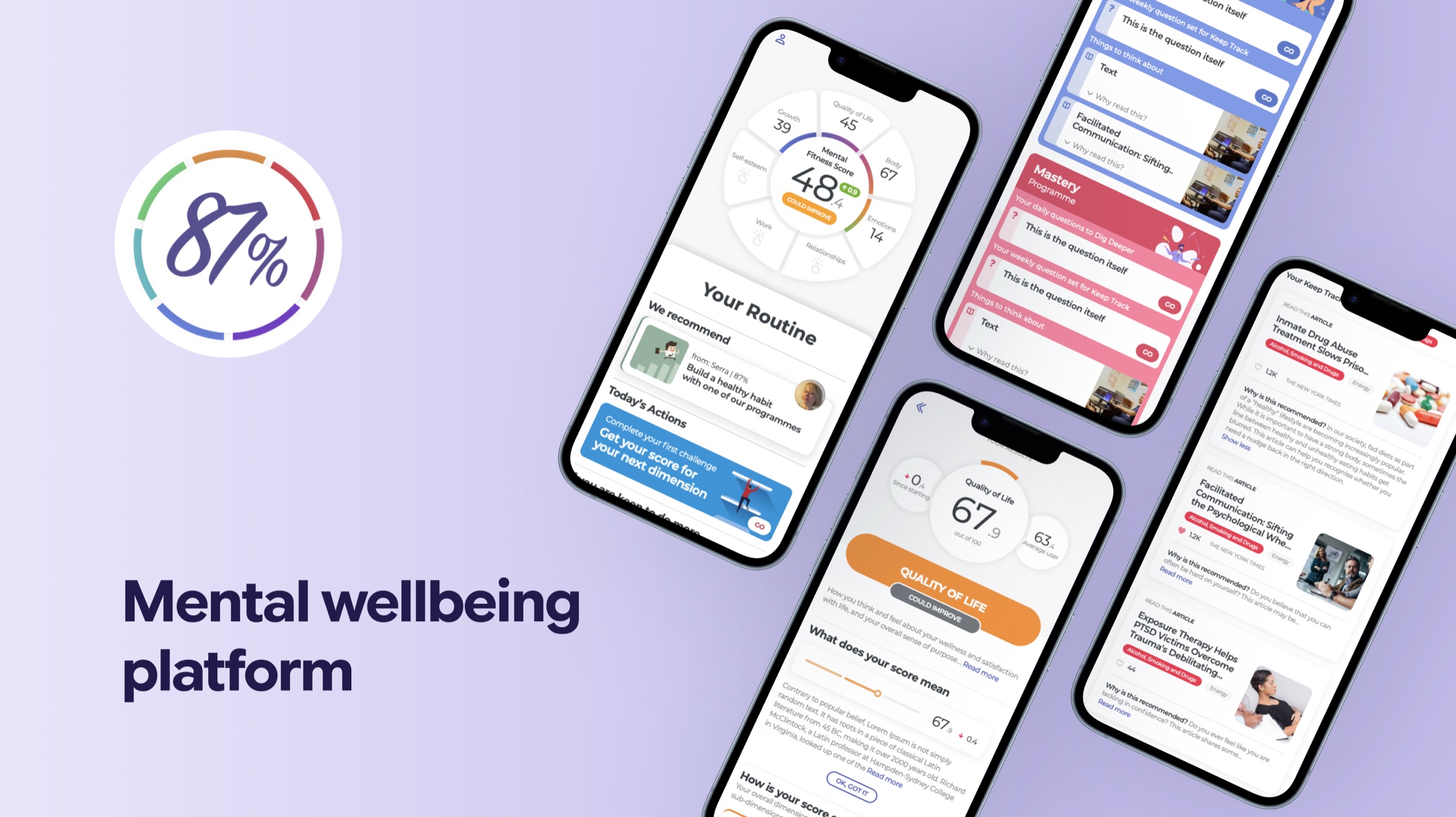
Most people can't tell you how they're really doing — and neither can the organizations they work for. To address this, I designed a science-backed mobile app that turns an invisible problem into an actionable score across seven dimensions of mental fitness.
Here's the uncomfortable truth about mental wellbeing in the workplace: everyone knows it matters, and nobody can measure it. Organizations spend billions on wellness programs, EAPs, and perks — but when asked "how is your workforce actually doing?", the answer is usually a shrug.
On the individual side, it's even more stark. Most people can't articulate their own mental state beyond "fine" or "stressed." There's no equivalent of stepping on a scale or checking your blood pressure.
87%'s founders — backed by a scientific advisory team — wanted to change this. Their challenge: design a platform that makes mental wellbeing as measurable and improvable as physical fitness.
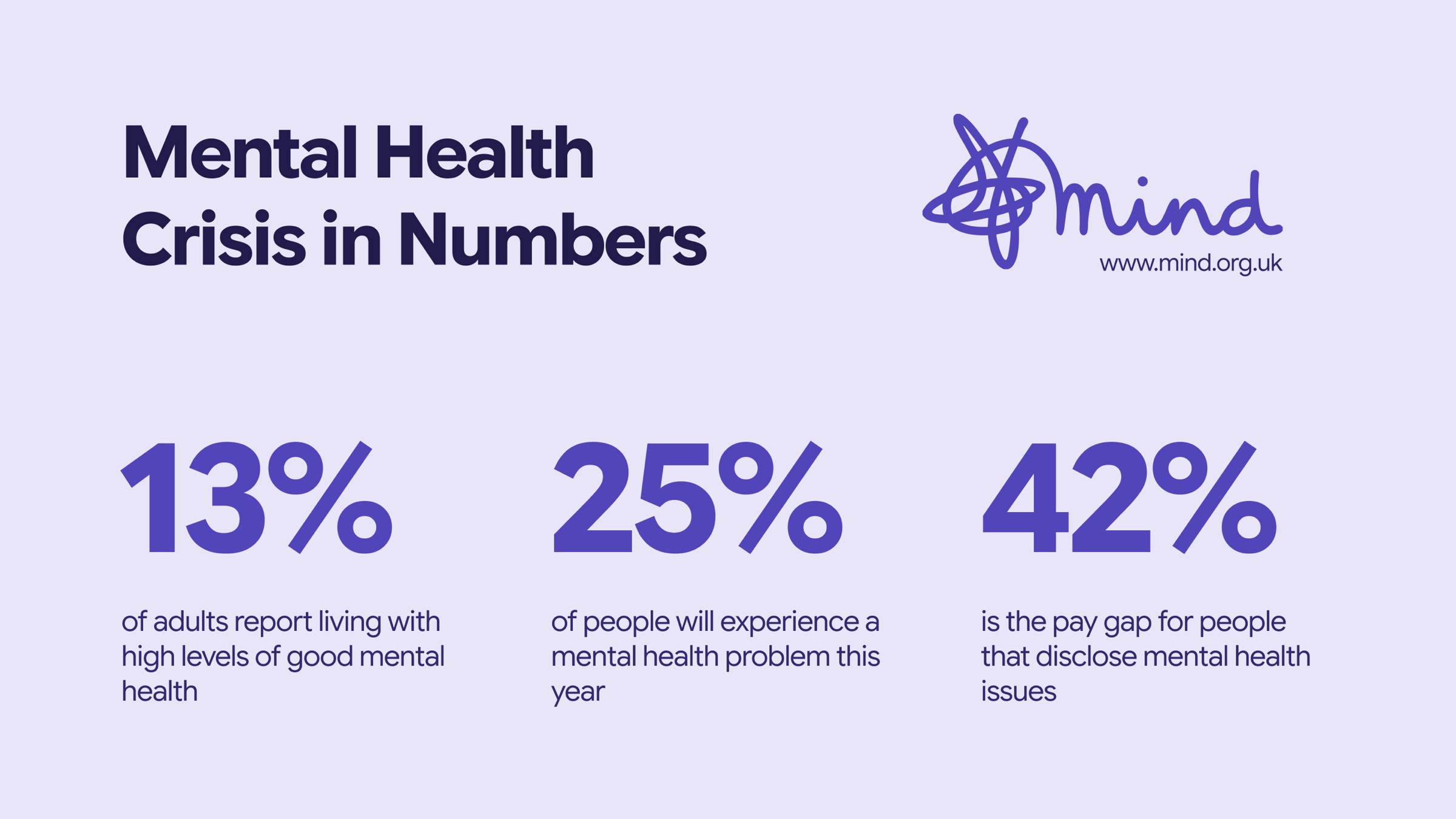
Before designing anything, I needed to understand why existing approaches to mental wellbeing measurement failed. Clinical assessments work for diagnosis but create anxiety and stigma. Wellness apps work for mindfulness but don't produce meaningful data.
The research revealed a fundamental tension: to get honest data about mental health, you need people to feel safe. But every existing tool signals evaluation, not safety. The design challenge was about creating a context where honesty felt natural.
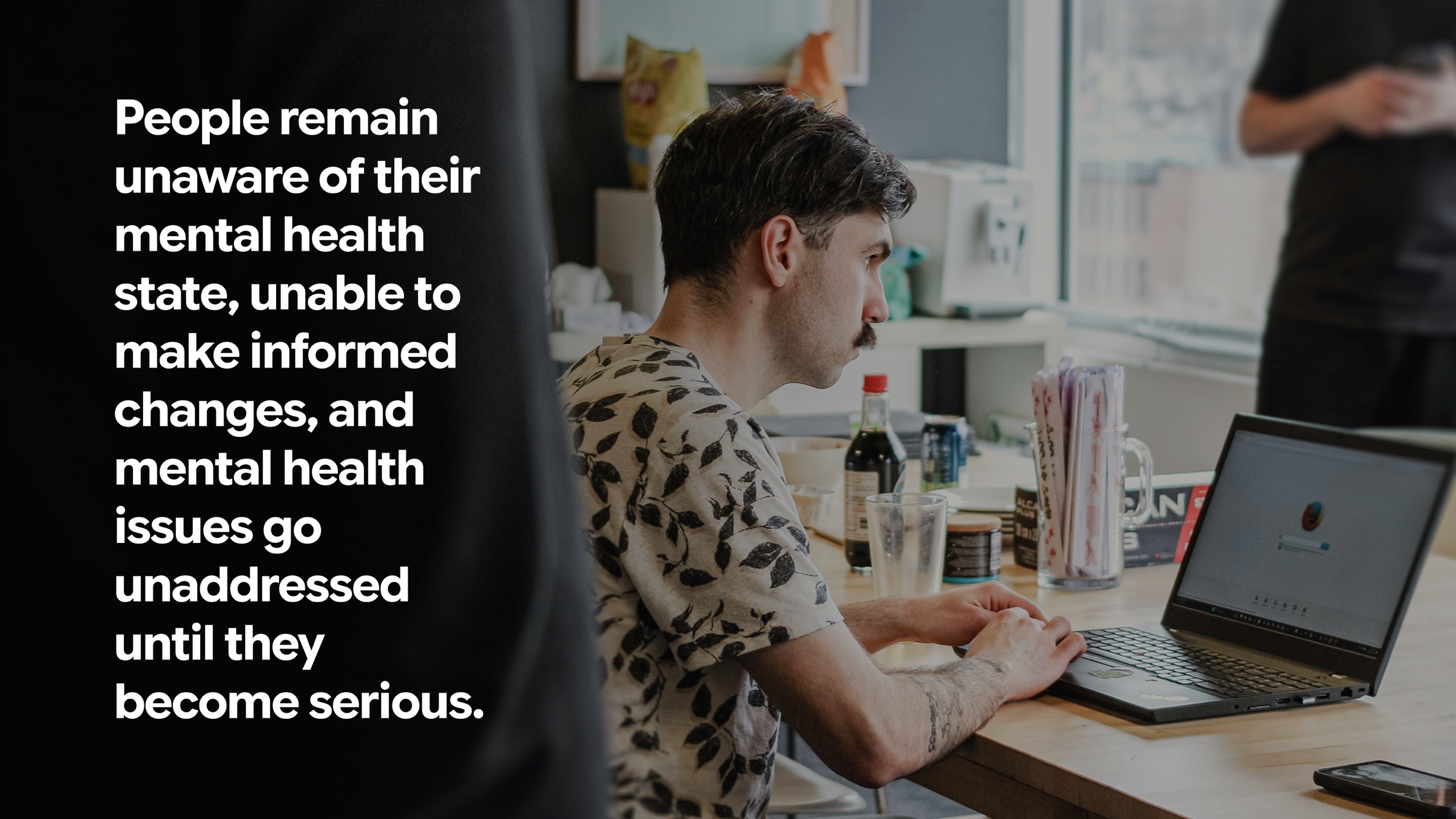
The research led to one foundational reframe: mental wellbeing should feel like a fitness score, not a medical report. When you step on a scale, you don't feel judged — you feel informed. That's the emotional register the platform needed to hit.
This crystallized into a product bet and three core design principles.
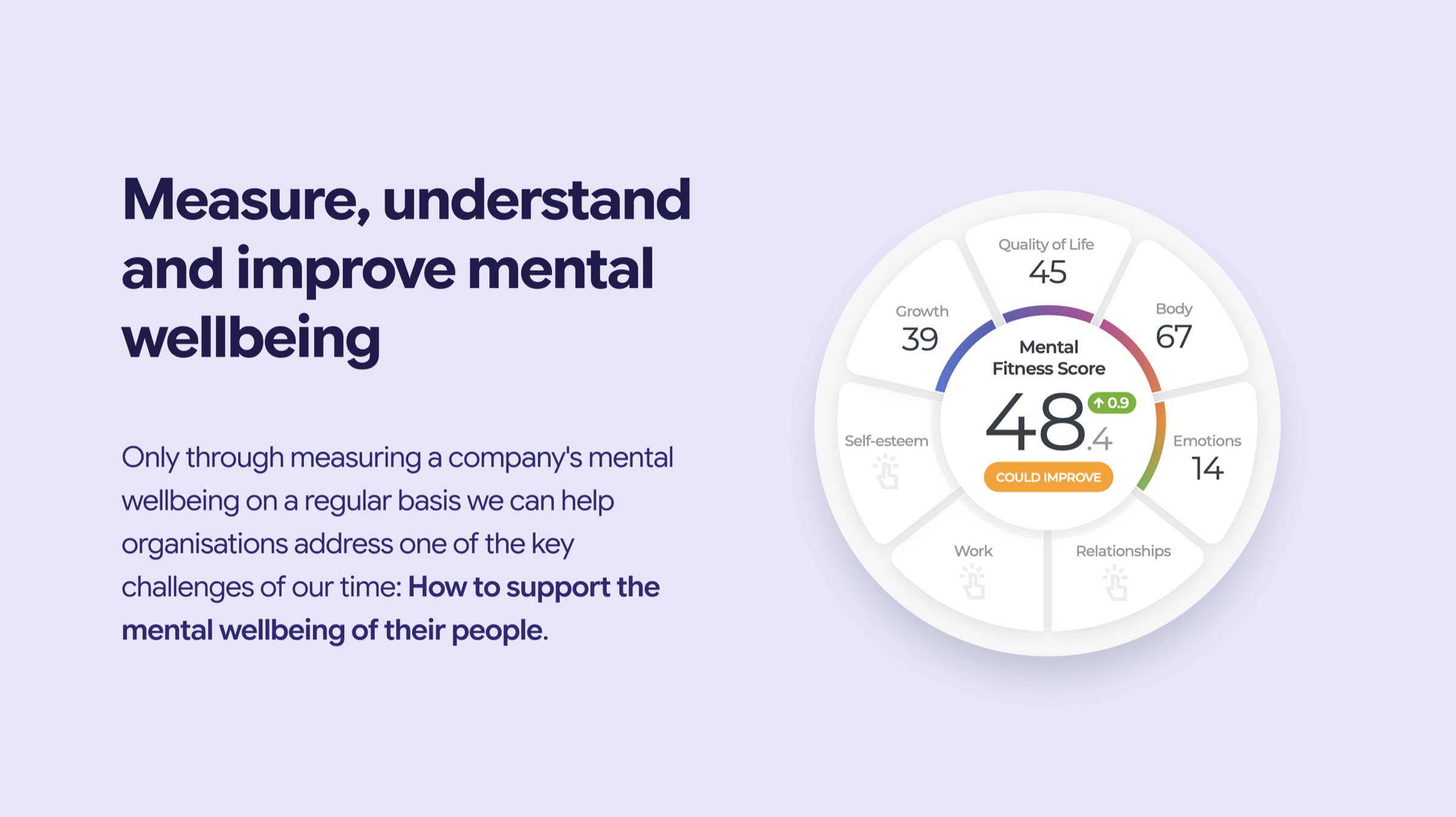
Instead of clinical labels, the platform uses a simple number — your Mental Fitness Score. This reframes mental health as something you improve, not something you're diagnosed with.
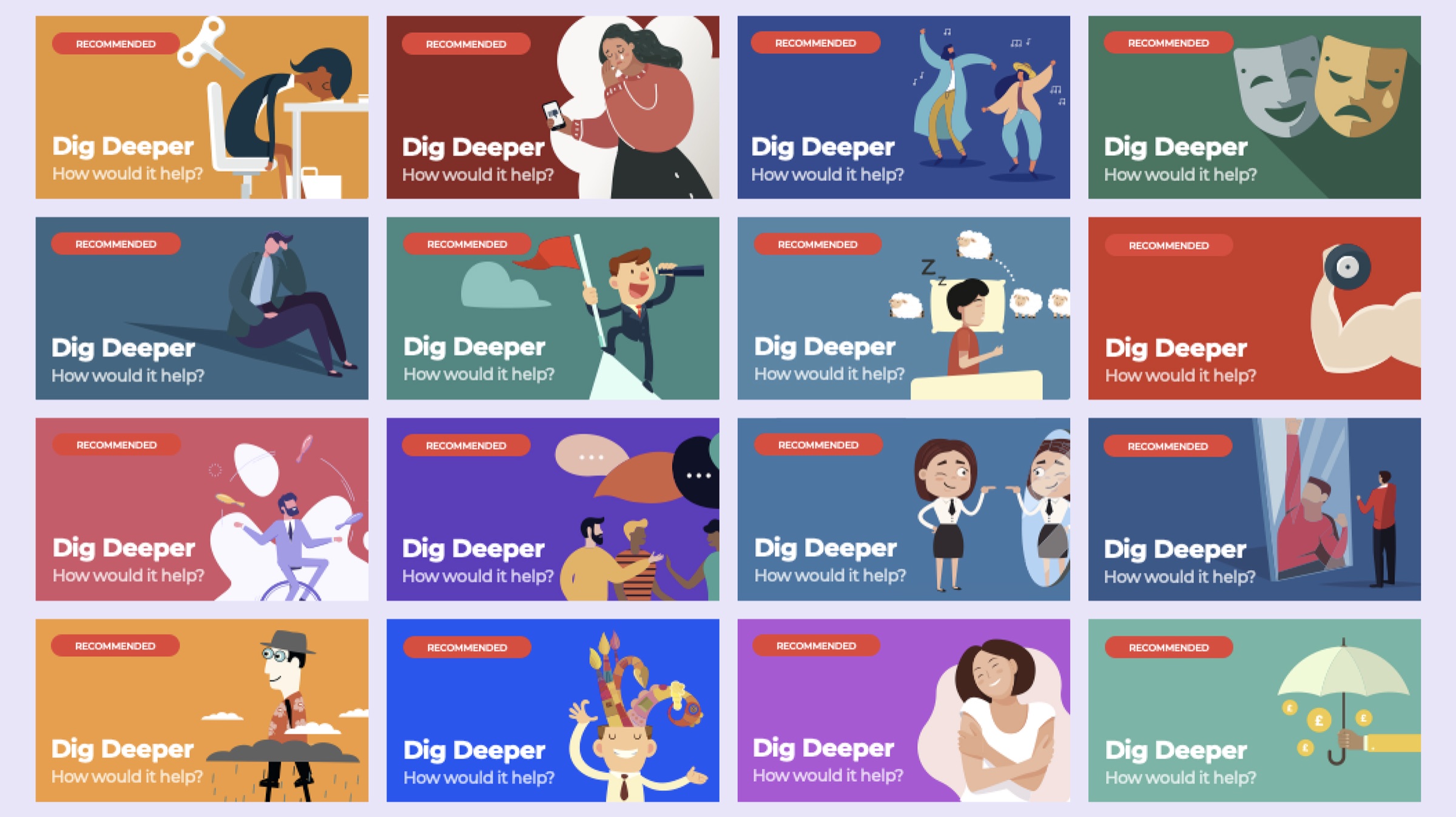
Soft purples, warm oranges, illustration-driven program cards, generous whitespace. Every visual choice signals safety and approachability. In a domain where honesty determines data quality, the aesthetic is functional.
New users see a clean, simple dashboard. Deeper insights, sub-scores, and historical trends reveal themselves as people engage more. Someone checking in for the first time shouldn't feel like they've opened a medical chart — they should feel like they've opened a compass.
"We weren't building a therapy app. We were building a mirror — one that shows you how you're really doing across the dimensions that matter, and gives you a clear path to improve."
The Mental Fitness Score is visualized as a radial wheel broken into seven dimensions: Quality of Life, Body, Emotions, Relationships, Work, Self-Esteem, and Growth. One glance tells you where you stand.
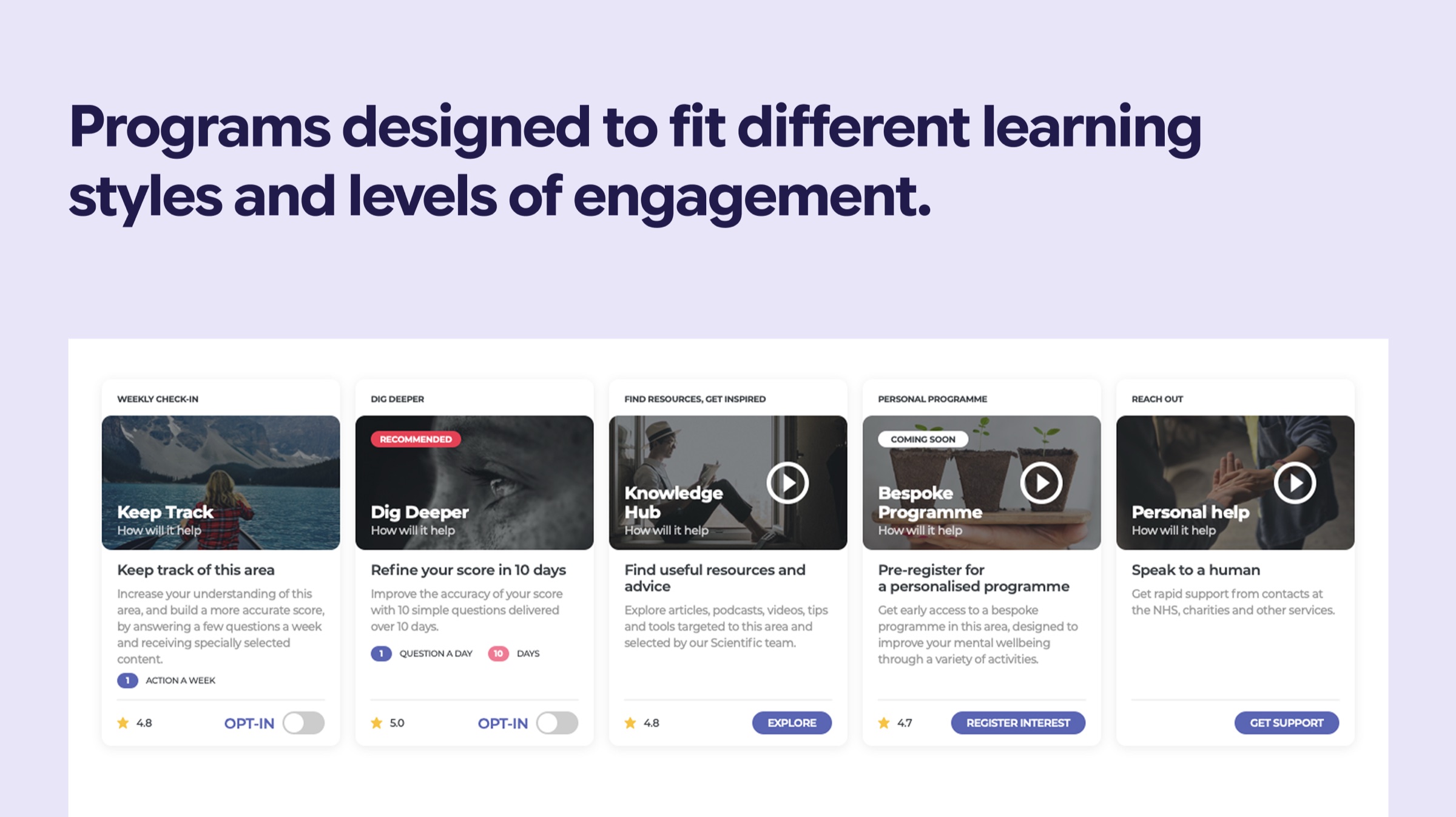
Behind the score sits a tiered program structure — five levels of engagement that meet people exactly where they are.
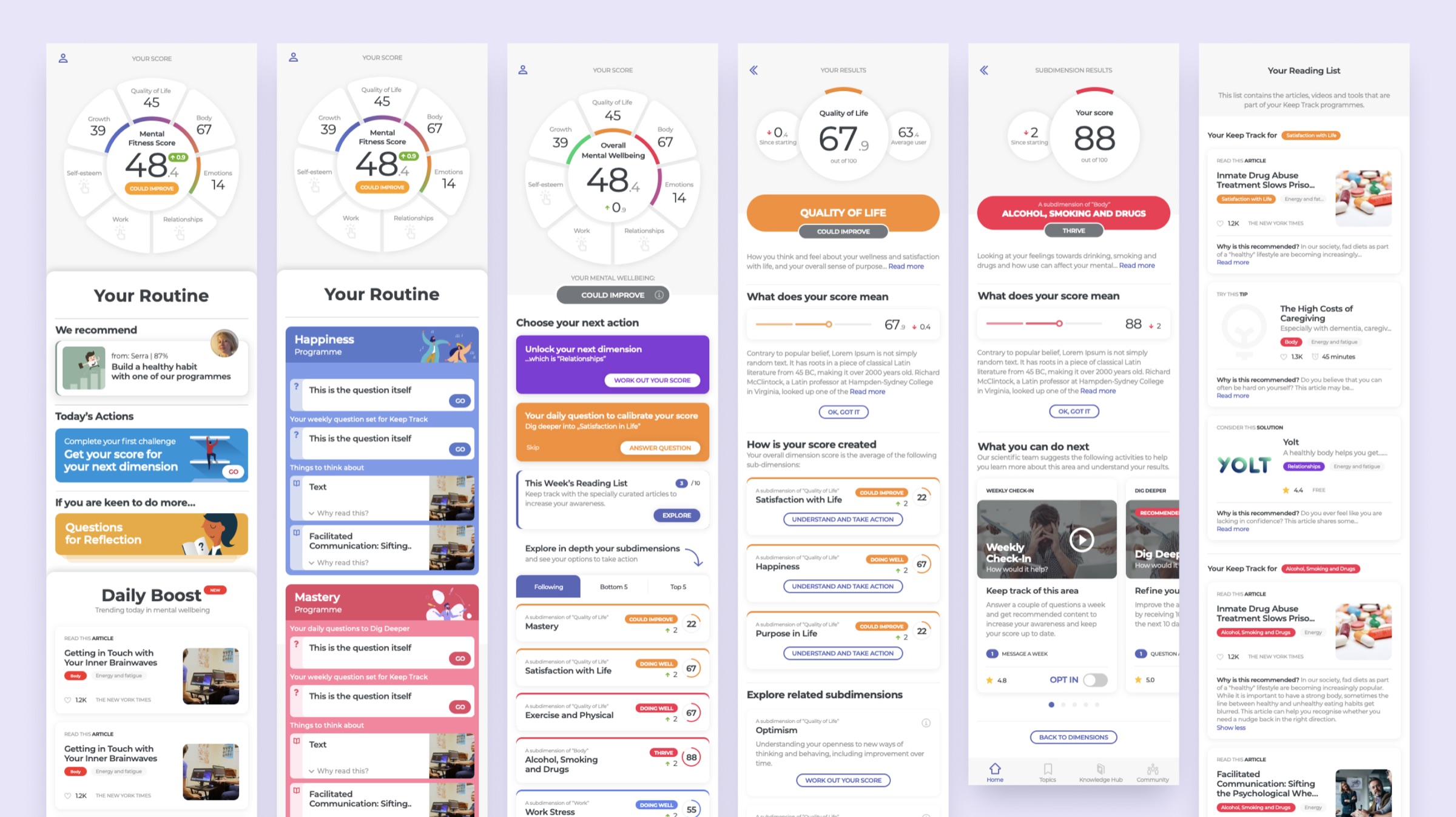
Every design decision maps directly to a documented problem — the invisibility of mental health, the stigma around measurement, and the gap between awareness and action.
Seven dimensions visualized as a wheel. Way more scannable than a table, and it naturally invites curiosity about areas that need attention. The shape itself communicates balance as the goal.
Five levels: Keep Track, Dig Deeper, Knowledge Hub, Bespoke Programme, and Personal Help. The platform meets people where they are — someone not ready for therapy can still track their score weekly.
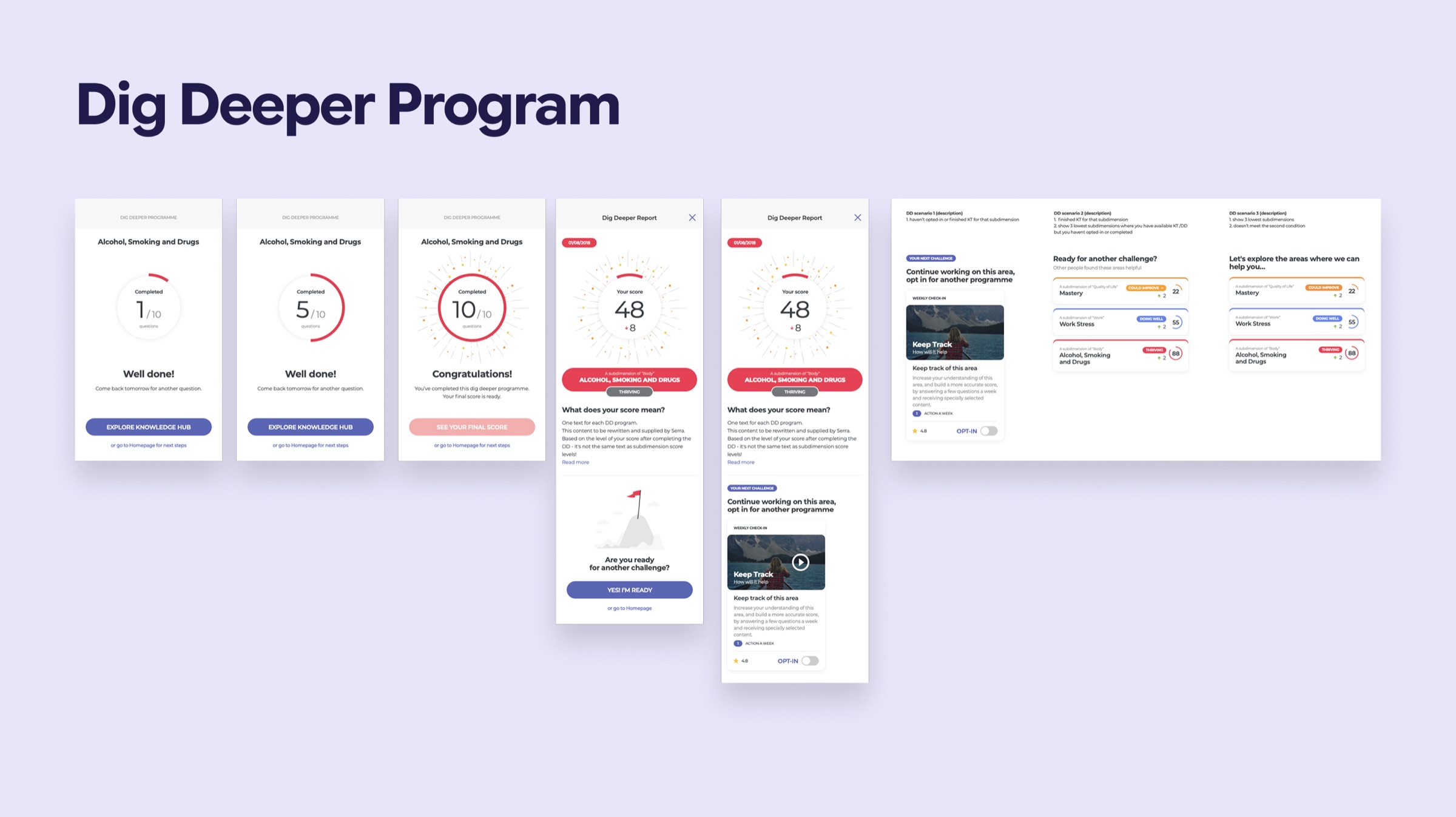
The 10-day Dig Deeper program marks days 1, 5, and 10 with celebrations. It breaks a potentially heavy experience into manageable chunks and gives people a sense of progress.
Every score, question, and program was developed with a scientific advisory team. This gave organizations confidence to deploy it as a legitimate wellbeing instrument.
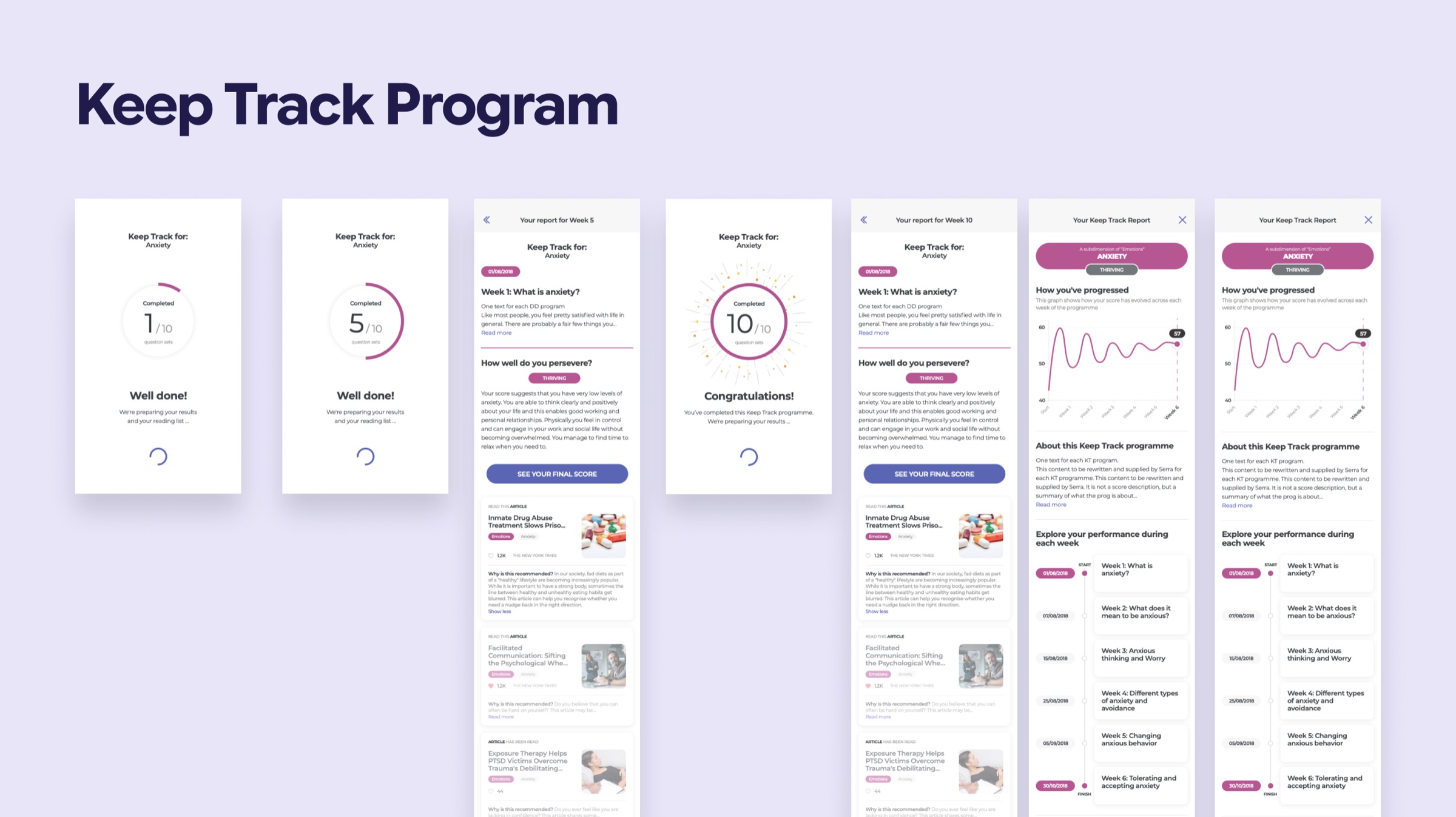
The biggest challenge in mental wellbeing isn't lack of solutions — it's lack of measurement. By framing mental health as a score to improve rather than a condition to diagnose, the platform lowered the barrier to engagement.
The Mental Fitness Score gave both individuals and organizations a concrete, trackable number, enabling action for the first time.
Aggregate anonymized insights replaced guesswork — allowing HR and leadership teams to make informed decisions about support programs based on real data.
By reframing mental health as a fitness score, engagement felt safe and approachable. This directly increased honest self-reporting — the foundation of the product's value.
The five-tier program structure serves users at every stage — from a quick weekly check-in to professional crisis support. One platform covers the full spectrum.
"The best wellbeing tools don't ask people to be vulnerable. They create a context where honesty feels natural. 87% doesn't diagnose — it measures. And that distinction is what makes people willing to be truthful about how they're really doing."